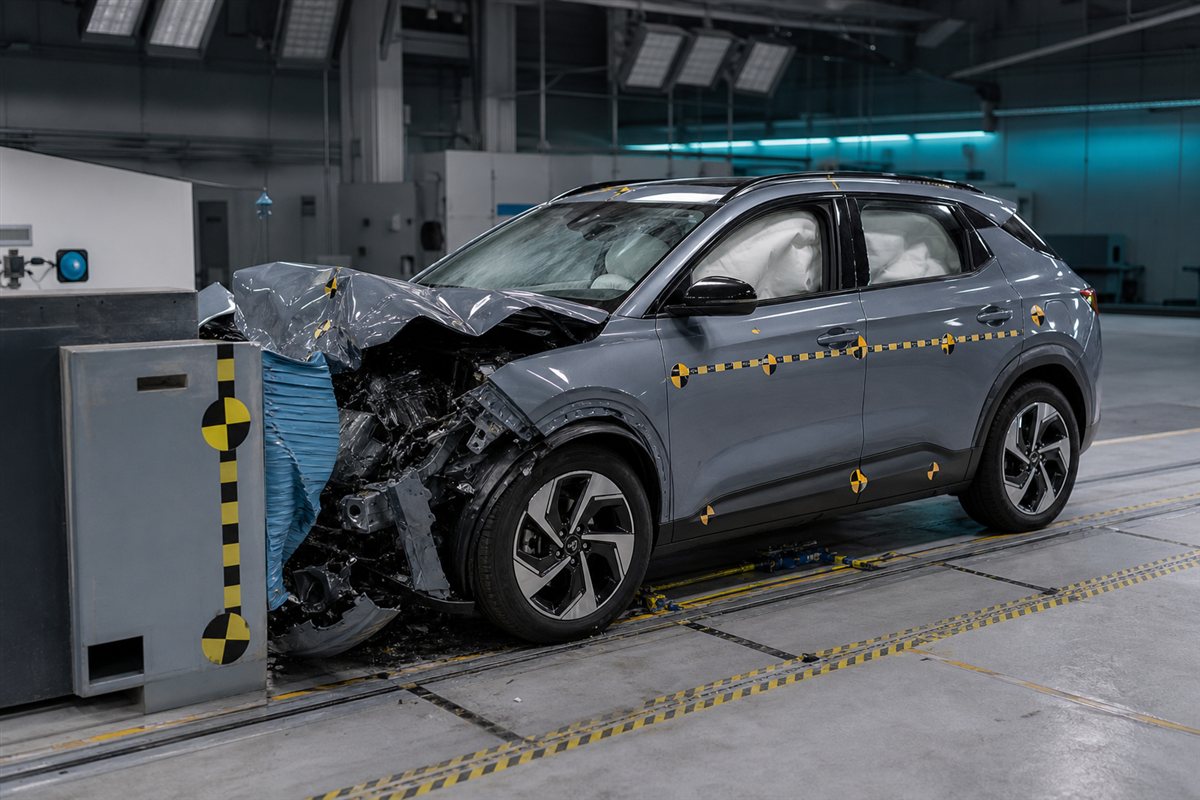
Tesla loves to talk about safety, and skeptics love to roll their eyes at it. The nice thing is that nobody has to take Tesla’s word for anything: independent organizations buy these cars, strap crash dummies into them, and slam them into barriers on camera. We don’t run crash tests at VoltEdge — nobody outside those labs does — so this guide does the next most useful thing: it explains what each rating system actually measures, then lists what each Tesla holds today, with the primary source attached to every number.
That last part matters more than usual this year. A lot of Tesla safety coverage — including the earlier version of this page — still repeats 2025 award results as if they were current. They are not. We re-pulled every figure below directly from NHTSA’s ratings API and the IIHS ratings pages on July 28, 2026, and several claims we had been carrying did not survive that check — three factual errors plus a set of figures we could not re-verify. All of them are corrected or cut below, and we list exactly which ones and why. If you want the broader argument about whether Teslas are among the safest cars on the road, we make that case separately. This page is the decoder ring.
What changed for 2026 (read this first)
Three things are worth knowing before the model-by-model detail. Two of them are changes at the rating bodies. The third is a mistake of our own that we are correcting here. Together they mean the sentence “every Tesla is a 5-star, award-winning car” is no longer accurate.
1. IIHS raised the bar, and most Teslas fell off the list. For the 2026 award year, exactly one Tesla appears on the IIHS winners list: the Cybertruck crew cab pickup, Top Safety Pick+. The Model 3 and Model Y — which held Top Safety Pick and Top Safety Pick+ respectively for 2025 — are not on the 2026 list at all.
2. Three Teslas have no NHTSA overall rating for 2026. As of this writing NHTSA publishes an overall star rating for the 2026 Model Y and 2026 Cybertruck only. The 2026 Model 3, Model S and Model X are listed as Not Rated overall. That is not a bad score — it means the agency has not published crash results for that specific model year and configuration yet (see below).
3. The Cybertruck’s rollover rating is four stars, not five. This one is a correction to our own page. NHTSA rates the 2026 Cybertruck five stars overall, five frontal and five side — but four stars for rollover resistance, with a measured rollover risk of 12.4%. We previously published five stars across the board. That was wrong, and it is fixed below.
None of this is evidence that a Tesla is unsafe. It does mean the honest summary is longer than one sentence, which is the point of this page.
The three rating bodies, in plain English (NHTSA vs IIHS vs Euro NCAP)
NHTSA is the U.S. government — the National Highway Traffic Safety Administration. Its New Car Assessment Program awards one to five stars based on instrumented crash tests: a full-width frontal impact, side impacts, and a rollover-resistance measurement. Five stars is the ceiling, and a surprising number of new cars get there, so think of NHTSA as the baseline test.
IIHS — the Insurance Institute for Highway Safety — is funded by insurers, who have a direct financial interest in finding the cars that hurt people. Its tests are deliberately nastier (the small overlap front test crushes just 25% of the car’s front end into a barrier), it grades on a four-step scale of Good / Acceptable / Marginal / Poor, and it hands out two awards: Top Safety Pick and the harder Top Safety Pick+.
Euro NCAP is the European consumer-testing consortium. Instead of stars-plus-awards, it publishes four percentage scores — adult occupant, child occupant, vulnerable road users, and safety assist — and a car must clear minimum thresholds in all four to earn five stars. It’s the most granular of the three, and currently the toughest grader of active-safety tech.
How to read a 5-star NHTSA rating
NHTSA’s stars are relative, not absolute: they compare a vehicle’s measured injury risk in the frontal, side, and rollover tests against the average vehicle. Five stars overall means your injury risk in a crash is well below that average. The overall star count is a weighted blend of the three categories, so always look at the breakdown — a car can carry five stars overall while hiding a four-star category. A Tesla does exactly that: the 2026 Cybertruck is five stars overall and five in both crash categories, but four stars for rollover resistance. The rollover figure is where tall, heavy vehicles traditionally give stars back, and a pickup with a high roofline is not exempt just because its battery sits low.
“Not Rated” is not a score. NHTSA rates a specific model year, body style and drivetrain — and a rating does not automatically carry forward when a car is refreshed or a new model year opens. For 2026, NHTSA publishes overall stars for the Model Y and Cybertruck; the Model 3, Model S and Model X currently show Not Rated in the crash categories. The Model S and Model X do carry a published 2026 five-star rollover result (measured rollover risk 5.7% and 9.3% respectively) with no frontal or side result alongside it. If you are cross-shopping, that is a data gap to be aware of, not evidence of a poor result.
What IIHS Top Safety Pick+ actually requires
The rules changed for 2026, and that change is why the Tesla lineup lost awards. Announcing the 2026 criteria on March 24, 2026, IIHS said it was “asking automakers to make excellent protection for back seat passengers the norm.” Here is the practical difference:
| Requirement | 2025 award year | 2026 award year |
|---|---|---|
| Small overlap front | Good (both awards) | Good (both awards) |
| Updated side test | Good (both awards) | Good (both awards) |
| Updated moderate overlap front | Good for Top Safety Pick+; Acceptable was enough for Top Safety Pick | Good required for both awards |
| Headlights | Acceptable or Good, standard on all trims | Acceptable or Good, standard on all trims |
| Pedestrian front crash prevention | Acceptable or Good | Acceptable or Good for Top Safety Pick; Good for Top Safety Pick+ |
| Vehicle-to-vehicle front crash prevention 2.0 | Not required | Acceptable or Good required for Top Safety Pick+ |
| Front crash prevention availability | — | Must be standard for either award |
The moderate overlap front test has since 2022 put a second dummy in the back seat to measure rear-passenger protection. Moving that test from “Acceptable is fine” to “Good or nothing” is what knocked several vehicles off the 2026 list, the Model 3 among them. The new vehicle-to-vehicle evaluation is also meaningfully harder than the one it replaced: runs at 31, 37 and 43 mph against a passenger car, a motorcycle and a semitrailer.
Worth keeping in perspective: even with the tougher rules, 63 vehicles qualified for a 2026 award as of the March 2026 announcement — 45 Top Safety Pick+ and 18 Top Safety Pick — up from 48 at the same point the previous year. The bar moved and most of the industry cleared it. IIHS also publishes ratings the awards don’t hinge on (roof strength, head restraints, LATCH ease-of-use, seat belt reminders), which is why a car can win an award while carrying an Acceptable or Marginal grade elsewhere on its scorecard.
Euro NCAP’s four scores
Adult occupant covers protection of the driver and front passenger across frontal, side, and whiplash tests — anything above 90% is elite. Child occupant measures protection of child dummies in the rear plus how well the car accommodates child seats. Vulnerable road users grades what the car does to the pedestrian or cyclist it hits — hood deformation zones, pop-up mitigation, and autonomous braking for people and bikes. Safety assist grades the active systems: automatic emergency braking, lane support, speed assistance, and driver monitoring. That last category is where camera-based systems like Tesla’s get stress-tested by an independent lab — relevant context if you’re wondering how safe Autopilot really is.
Tesla Model 3 ratings
NHTSA: the 2026 Model 3 is currently listed as Not Rated — no overall, frontal, side, rollover or side-pole result published for the 2026 car in either drivetrain. Earlier Model 3 model years were rated; those ratings attach to those model years, not to the 2026 build.
IIHS: ratings are published for 2025–26 Model 3, and this is the clearest example on the page of how one grade decides an award. Its scorecard reads Good small overlap front, Good side, Acceptable updated moderate overlap front, Acceptable headlights, Good pedestrian front crash prevention (standard) and Good vehicle-to-vehicle front crash prevention 2.0 (standard). Seat belt reminders rate Marginal and LATCH ease-of-use Acceptable.
Read that against the 2026 criteria table above and the gap is a single cell. The Model 3 already meets the Top Safety Pick+ requirement for both crash-avoidance tests, and it is Good in two of the three crash tests. It misses because the updated moderate overlap front test comes back Acceptable — and under the 2026 rules Acceptable is no longer enough for either award. Inside that test, every driver measure is Good and every rear-passenger measure is Good except one: rear passenger chest, rated Marginal. One measure, on one dummy, in one test, is the entire difference between an award and no award.
That is not a scandal, and it is not a reason to avoid the car. It is a genuinely useful thing to know if you regularly carry adults or older kids in the back seat.
Tesla Model Y ratings
The Model Y is the only Tesla with a clean five-star sweep across every 2026 NHTSA category.
NHTSA: the 2026 Model Y is rated five stars overall, five stars frontal (driver and passenger), five stars side (barrier and pole) and five stars rollover, in both drivetrains. Measured rollover risk is 8.6% (AWD) and 8.9% (RWD), with no tip in the dynamic test. NHTSA’s 2026 record for this car also flags electronic stability control, forward collision warning and lane departure warning as standard. The agency’s 2026 entries for the Model 3, Model S, Model X and Cybertruck do not carry the forward-collision-warning or lane-departure-warning flags — which reflects what NHTSA has recorded, and is not by itself proof the equipment is absent from the car.
IIHS: here is the part most coverage gets wrong. The Model Y earned Top Safety Pick+ for the 2025 award year, and that result is real. But IIHS has not published a 2026 Model Y rating, and the Model Y does not appear on the 2026 winners list. Its published crashworthiness ratings are explicitly scoped by IIHS to earlier model years — small overlap front to 2020–25 models, moderate overlap and side to 2022–25 models, headlights to 2021–25 models, and the two front crash prevention ratings to 2025 models. In plain terms: the Model Y’s IIHS award is a 2025 award, and there is no 2026 IIHS result to replace it yet.
We are not going to guess at why. A redesigned car has to be re-tested before IIHS can publish anything, and absence of a rating is absence of data, not a verdict. If a 2026 result lands, we will update this page and say so.
Model S, X, and Cybertruck (what we know)
Model S: for 2026, NHTSA lists the Model S as Not Rated for overall, frontal, side and side-pole, with one published result: five stars for rollover resistance, measured rollover risk 5.7%, no tip. That 5.7% is the lowest figure in Tesla’s current NHTSA listings and is exactly what you would expect from a low, heavy sedan. IIHS has not rated the current Model S under its latest test battery.
Model X: the same pattern — Not Rated for the crash categories in 2026, with a published five-star rollover result and a measured rollover risk of 9.3%, no tip. IIHS has not rated the current Model X either. Both cars sell in small volumes, and low-volume models routinely go unrated; that is a data gap, not a red flag, but it does mean claims about how these two “score” today should be treated carefully.
Cybertruck: the skeptics’ favorite target is genuinely the best-documented Tesla on this page, and also the one we had wrong. NHTSA rates the 2026 Cybertruck five stars overall, five frontal, five side barrier and five side pole — but four stars for rollover resistance, with a measured rollover risk of 12.4% and no tip in the dynamic test. Our previous version of this page said five stars for rollover. It was four.
On the IIHS side the Cybertruck is the standout: it is the only Tesla on the 2026 IIHS winners list, holding Top Safety Pick+ in the large pickup class. It is also the only pickup of any brand to earn the “+” for 2026 — but it is not the only pickup with an award, because the Toyota Tundra crew cab earned the standard Top Safety Pick. Those two are the entire large-pickup winners list for 2026, and IIHS notes that no minicars, minivans or small pickups earned an award at all this year. The 2025 version of the Cybertruck award applied only to trucks built after April 2025; check the build date on any used example. Euro NCAP has no Cybertruck data, because it is not sold in Europe.
Why Teslas crash-test well
Four engineering ingredients keep showing up in these results. First, the low center of gravity: a half-ton battery mounted under the floor makes the whole car bottom-heavy, which shows up directly in NHTSA’s measured rollover-risk figures: 5.7% for the 2026 Model S, 8.6–8.9% for the Model Y and 9.3% for the Model X, all with a five-star rollover rating and no tip in the dynamic test. Second, the frunk: with no engine block up front, the entire nose is a programmable crumple zone that can spend more distance absorbing energy before anything stiff reaches the cabin. Third, the rigid battery pack doubles as structure — a stiff slab across the floor that resists side intrusion and keeps the passenger cell square while the extremities crumple. Fourth, advanced restraints: Tesla tunes its airbags and seat belt pretensioners using crash data from its own fleet, and the Good driver-injury measures on the current IIHS Model 3 scorecard — every driver measure in both front tests rated Good — are consistent with that.
Two honest limits on that story. The rollover advantage is real but it is not automatic — the Cybertruck’s four-star rollover rating is the counter-example, and shape matters as much as centre of gravity. And structural performance says nothing about rear-seat restraint tuning, which is precisely where the Model 3 loses its award. Good architecture is a strong start, not a finished result.
Tesla safety ratings at a glance (verified July 28, 2026)
Every entry below was checked against the primary source on July 28, 2026 — including the blanks, which record that no result is published rather than that a result was poor. NHTSA figures are for the 2026 model year; where NHTSA has not published a result, the cell says so rather than borrowing an older model year’s stars.
| Model (2026 MY) | NHTSA overall | NHTSA rollover | IIHS 2026 award |
|---|---|---|---|
| Model 3 | Not Rated | Not Rated | None — misses on Acceptable moderate overlap front |
| Model Y | ★★★★★ (5 frontal, 5 side) | ★★★★★ — 8.6% AWD / 8.9% RWD | None published for 2026 (held Top Safety Pick+ for 2025) |
| Model S | Not Rated | ★★★★★ — 5.7% | Not rated under current protocol |
| Model X | Not Rated | ★★★★★ — 9.3% | Not rated under current protocol |
| Cybertruck | ★★★★★ (5 frontal, 5 side) | ★★★★☆ 4 stars — 12.4% | Top Safety Pick+ — the only Tesla on the 2026 list |
NHTSA values are from the agency’s public safety-ratings API for the 2026 model year, AWD configuration except where a drivetrain is named. “Not Rated” means no published result for that model year, not a poor result. Percentages are NHTSA’s measured rollover risk. IIHS awards are for the 2026 award year.
What we removed from this page, and why
Correcting a page is only useful if you can see what changed. Four things came off this page in the July 28, 2026 pass:
- “Five stars in every category, every model.” Wrong on two counts — the Cybertruck’s rollover is four stars, and three 2026 Teslas have no overall rating at all.
- “The only pickup to hold that award.” The Cybertruck is the only pickup with Top Safety Pick+ for 2026; the Toyota Tundra crew cab holds the standard award.
- Euro NCAP percentage scores. We could not re-verify the individual adult/child/VRU/assist percentages against Euro NCAP’s own published results in this pass, so we cut the numbers rather than carry figures we had not personally checked. The explanation of what those four scores mean stays, and Euro NCAP’s results search is linked below.
- Superlatives we could not source. “Lowest rollover risk NHTSA ever recorded,” “fifth consecutive year,” “first SUV ever to score five stars in every subcategory,” and a driver-assistance “first” sourced to news write-ups rather than the agency. Some of these may well be true. None of them survived a primary-source check, so none of them belong on a page whose entire job is being checkable.
Sources, and how to check them yourself
Every figure on this page was read from one of these on July 28, 2026. They are the primary publishers — not aggregators, not press coverage — and you can re-run the same checks in a few minutes:
- NHTSA vehicle safety ratings — the U.S. government’s star ratings. Search by model year, make and model; the 2026 Tesla figures above come from NHTSA’s public safety-ratings data for model year 2026.
- IIHS 2026 Top Safety Pick winners — filter by make to see every Tesla on the list. For 2026 that filter returns one vehicle.
- IIHS 2026 Tesla Model 3 ratings — the full scorecard, including the rear-passenger chest measure inside the moderate overlap front test.
- IIHS announcement of the 2026 award criteria (March 24, 2026) — the source for the criteria comparison, the quoted line, and the 63 / 45 / 18 award counts.
- Euro NCAP results search — for the European protocol scores, which use a different test regime and are not directly comparable to NHTSA stars or IIHS grades.
Ratings attach to a specific model year and sometimes a specific build date — verify your exact configuration before you buy, especially on the used market. If you’re taking delivery soon, our new owner first-week checklist covers the safety settings worth enabling on day one.
Shopping for a Tesla? Use our referral link to earn exclusive benefits: ts.la/tyler468767
Frequently Asked Questions
Which Teslas have an IIHS award for 2026?
One: the Cybertruck crew cab pickup, which holds Top Safety Pick+. The Model 3 and Model Y are not on the 2026 IIHS winners list. Both held awards for the 2025 award year — Top Safety Pick and Top Safety Pick+ respectively — and those results remain valid for those model years.
Does “Not Rated” mean the car failed a crash test?
No. It means the rating body has not published a result for that specific model year and configuration. NHTSA currently shows the 2026 Model 3, Model S and Model X as Not Rated in the crash categories. A car with no published rating has not been graded, not graded badly.
What does a 5-star NHTSA rating actually mean?
NHTSA’s stars compare a vehicle’s measured injury risk in frontal, side and rollover testing against the average vehicle — five stars overall means crash-injury risk well below average. Always read the category breakdown, because a car can hold five stars overall and four in one category. The 2026 Cybertruck is exactly that case: five overall, four for rollover.
What’s the difference between IIHS Top Safety Pick and Top Safety Pick+?
For the 2026 award year both require Good ratings in the small overlap front, updated moderate overlap front and updated side tests, plus Acceptable-or-Good headlights standard on all trims and standard front crash prevention. The “+” additionally requires a Good rating in pedestrian front crash prevention and an Acceptable-or-Good rating in the updated vehicle-to-vehicle front crash prevention 2.0 evaluation.
Why doesn’t the Model 3 have a 2026 IIHS award?
Because of one grade. IIHS rates the 2025–26 Model 3 Acceptable rather than Good in the updated moderate overlap front test, driven by a Marginal rear-passenger chest measure. For 2025 an Acceptable there was still enough for the standard Top Safety Pick; for 2026 IIHS requires Good for either award. Everything else on the Model 3’s scorecard — Good small overlap, Good side, Good standard pedestrian and vehicle-to-vehicle front crash prevention — already meets Top Safety Pick+ requirements.
Has the Cybertruck been crash-tested?
Yes, and it is the best-documented Tesla in this guide. NHTSA rates the 2026 Cybertruck five stars overall with five stars frontal and side, and four stars for rollover resistance (12.4% measured rollover risk). IIHS named it a Top Safety Pick+ for 2026 — the only pickup with the “+”, though the Toyota Tundra crew cab holds the standard award. Euro NCAP has not tested it, because it is not sold in Europe.
Do these ratings apply to older or used Teslas?
Not automatically. Ratings attach to specific model years and sometimes build dates — the Cybertruck’s 2025 IIHS award covered trucks built after April 2025, and IIHS scopes the Model Y’s current crashworthiness ratings to model years 2020–25 and 2022–25 depending on the test. Check your exact model year on the IIHS and NHTSA sites rather than assuming a rating carries over.
Do crash-test ratings say anything about Autopilot?
Mostly no — crash tests measure how a car protects you in an impact. Active systems are graded separately: IIHS now runs a vehicle-to-vehicle front crash prevention evaluation at 31, 37 and 43 mph against car, motorcycle and semitrailer targets, and Euro NCAP’s Safety Assist score covers emergency braking and lane support. For the full picture, see our guide to how safe Autopilot is.
Related: Are Teslas Among the Safest Cars on the Road? · How Safe Is Autopilot, Really? · New Owner First-Week Checklist