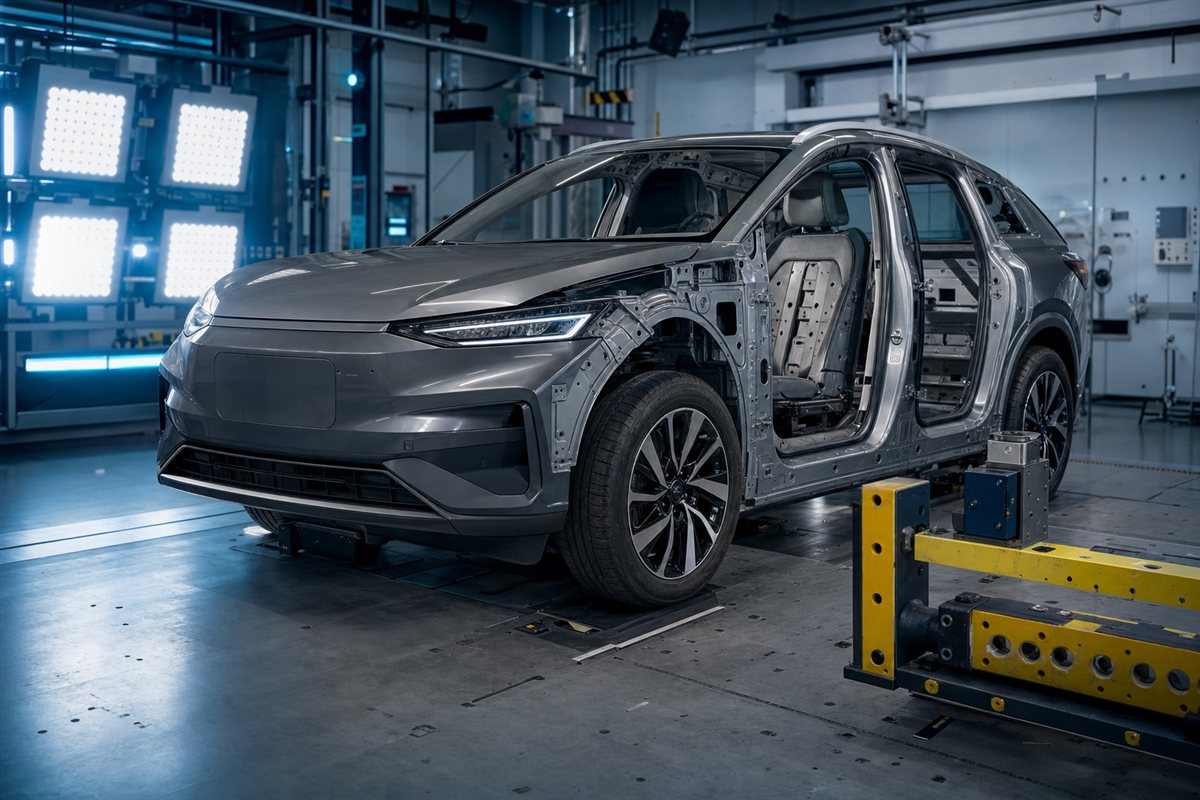
Quick answer: By every independent measure that exists — NHTSA, IIHS, and Euro NCAP — Teslas rank at or near the top of everything they've been tested against. No agency publishes an official "safest car on Earth" ranking, so nobody can honestly claim the crown outright. But if you stacked up the third-party evidence for any brand's whole lineup, Tesla's stack would be one of the tallest in the industry.
What "safest" actually means (the 3 rating bodies)
Before any claims get made, it helps to know who actually does the testing — because "safest car" gets thrown around loosely, and the three organizations that matter measure different things.
NHTSA (the National Highway Traffic Safety Administration) is the U.S. government's program. Its New Car Assessment Program crashes cars head-on into barriers, slams them sideways, and measures rollover resistance, then awards 1 to 5 stars overall and per category. Five stars is the ceiling — NHTSA doesn't rank cars against each other beyond that.
IIHS (the Insurance Institute for Highway Safety) is funded by insurers, who have a direct financial interest in knowing which cars hurt people. Its tests are generally tougher and updated more aggressively than NHTSA's — small overlap front crashes, the updated moderate overlap test with a rear passenger dummy, headlight quality, and pedestrian crash prevention. Its top awards are Top Safety Pick and Top Safety Pick+.
Euro NCAP is Europe's independent consortium and arguably runs the most comprehensive protocol of the three, scoring cars in four categories: adult occupant, child occupant, vulnerable road users (pedestrians and cyclists), and safety assist (the active-safety electronics). We break down how all three programs work in our companion piece, crash-test ratings explained.
A car that does well in one program might be mediocre in another. The reason Tesla's safety reputation holds up is that its cars do well in all three — across multiple models and multiple test cycles.
Tesla's NHTSA 5-star record
Every vehicle Tesla currently sells has earned a 5-star overall rating from NHTSA. The Model 3 scored five stars overall and in every category — frontal crash, side crash, and rollover. The Model Y matched it. The Model S has long held five stars, and per Tesla, the 2022 Model S was the only car that year to combine a 5-star Euro NCAP rating with five stars in every NHTSA subcategory. The Model X, according to Tesla and widely reported at the time, was the first SUV ever to earn five stars in every category and subcategory. Even the Cybertruck joined the club, earning a 5-star overall NHTSA rating in early 2025.
The most famous claim in this space needs careful handling, though. In 2018, Tesla announced the Model 3 had achieved "the lowest probability of injury of any vehicle ever tested by NHTSA," based on the agency's published injury-probability data. Outlets from Electrek to CNBC ran the numbers and the math checked out — but NHTSA itself told CNBC it does not rank vehicles in order of safety beyond the 5-star scale. So the accurate version is: Tesla's calculation from NHTSA's own data put the Model 3 at the top; NHTSA never crowned it.
The freshest NHTSA news is arguably the most impressive. In May 2026, NHTSA confirmed the 2026 Model Y is the first vehicle to meet the agency's new advanced driver-assistance benchmark — four new pass/fail tests covering automatic emergency braking for pedestrians, blind-spot warning, blind-spot intervention, and lane-keeping assist (reported by TechCrunch, May 7, 2026). Worth noting honestly: Tesla ran those tests itself and submitted results under a manufacturer self-certification option, and NHTSA says it will run confirmatory testing — but being first through the door on a brand-new federal benchmark is exactly the kind of result you'd expect from the safety leader. The benchmark applies to 2026 Model Ys built on or after November 12, 2025.
Rollover resistance: NHTSA's rollover measurements are where Tesla's low-slung battery architecture shows up most clearly. The Model Y posted a rollover risk of roughly 7.9% in NHTSA testing — among the lowest ever recorded for an SUV — and every Tesla earns five stars in the rollover category. Rollovers are historically the deadliest crash type per incident, so this matters more than most buyers realize.
IIHS Top Safety Pick results
The IIHS is the harder grader, which makes Tesla's record there meaningful. The 2025 Model Y earned Top Safety Pick+ — the institute's highest award — continuing a five-year streak of TSP/TSP+ recognition. It posted Good ratings in the crashworthiness evaluations including the updated moderate overlap front test that now scores rear-passenger protection, a test that has knocked plenty of well-regarded competitors down a tier.
The 2025 Model 3 earned Top Safety Pick — the standard award, not the plus. The reasons are specific and worth knowing: an Acceptable (rather than Good) rating in the updated moderate overlap test, driven by a Marginal score for rear-passenger chest protection, plus Acceptable-rated headlights. Translation: front-seat protection remains excellent, and the gap to TSP+ is about the back seat in one specific test geometry. The Cybertruck, for its part, earned IIHS Top Safety Pick+ for trucks built from April 2025.
The Model S and Model X don't currently hold IIHS awards for a simple, boring reason: the IIHS hasn't put current versions of the low-volume flagships through its full modern test battery. Absence of an award isn't a failing grade — it's an empty test slot.
Euro NCAP scores: the toughest test on Earth
Euro NCAP's 2025 protocol is the strictest consumer crash-test regime in the world, and it produced Tesla's best headline of the year: the refreshed Model 3 scored 359 out of 400 points and won Euro NCAP's Best-in-Class 2025 award for large family cars — just behind the Mercedes-Benz CLA, which Euro NCAP named its overall Best Performer of 2025. Category scores: 90% adult occupant, 93% child occupant, 89% vulnerable road users, 87% safety assist.
The refreshed Model Y ("Juniper") also earned five stars under the same 2025 protocol, with 91% adult occupant, 93% child occupant, 86% vulnerable road users, and 92% safety assist (Euro NCAP datasheet). The test car carried a full airbag array, an active hood for pedestrian protection, and a camera-based driver monitoring system that Euro NCAP specifically credited.
The flagships hold five-star Euro NCAP ratings from their own test cycles — Model S under the 2022 protocol (including a 98% safety assist score, per Tesla and Euro NCAP) and Model X under the 2019 protocol. Those scores aren't directly comparable to 2025 numbers because the protocol gets harder every cycle — which makes the 2025 results from the Model 3 and Model Y more impressive, not less.
Why EVs crash-test so well (it's mostly physics)
Tesla's results aren't magic, and being honest about that actually strengthens the case — the advantages are structural, repeatable, and baked into every car they build.
Low center of gravity. The battery pack — the heaviest single component — lies flat in the floor between the axles. That drops the center of mass to sports-car height even on the SUVs, which is why Tesla's rollover numbers are so strong. You can't retrofit this onto a gas SUV with an engine sitting up high.
No engine block, bigger crumple zone. A gas car's frontal crash structure has to manage a few hundred pounds of rigid engine that wants to enter the cabin. A Tesla's front end is mostly empty, engineered to do exactly one job in a crash: crumple progressively and bleed off energy before it reaches the occupants. More usable crush distance equals lower deceleration forces on bodies.
The battery pack as structure. The pack lives in a rigid, reinforced enclosure that doubles as a stressed structural member, stiffening the floor and helping the passenger cell resist intrusion in side impacts. Tesla has also reported its internal roof-crush testing exceeded four times vehicle weight on the Model 3 — beyond what the federal standard requires.
Weight, for better and worse. EVs are heavy, and in a two-car collision, mass tends to favor the heavier vehicle's occupants. That's an honest physics advantage for you — and an honest disadvantage for whatever you hit, which is part of why pedestrian-protection scores (where Tesla also does well) matter.
These advantages apply to most well-engineered EVs, not just Teslas — which is exactly why EVs as a class have been posting standout crash results across all three rating bodies.
Active safety: AEB, lane-keeping, blind-spot
Crash ratings measure what happens when the crash occurs. Active safety is about never getting there, and it's where Tesla's camera-and-software approach pays off because every car gets the full suite as standard equipment — no options packages, no trim gatekeeping.
Every Tesla ships with automatic emergency braking (vehicle and pedestrian/cyclist detection), forward collision warning, lane departure avoidance that actively steers you back, blind-spot collision warning, and obstacle-aware acceleration that cuts power if you floor it at a wall. Euro NCAP's safety-assist category scores reflect this: 92% for the 2025 Model Y and 87% for the Model 3, with the testers calling out the forward collision and AEB performance against both vehicles and vulnerable road users.
The 2026 Model Y passing NHTSA's four new ADAS tests — pedestrian AEB, blind-spot warning, blind-spot intervention, and lane assist — is the first federal validation of this stack, with the self-certification caveat noted above. And because Tesla pushes improvements over the air, the active-safety behavior of the fleet genuinely improves after purchase, something no crash rating captures. Autopilot itself is a bigger and more contested topic — we go deep on the data, the investigations, and the honest verdict in our companion piece on how safe Autopilot really is.
What Tesla's own safety report says (and what it doesn't)
Tesla publishes a quarterly Vehicle Safety Report, and the Q3 2025 edition reported one crash per 6.36 million miles with Autopilot engaged, one per 993,000 miles for Teslas without Autopilot, against a U.S. average of roughly one per 702,000 miles (Tesla data, as covered by Electrek and InsideEVs).
Taken at face value, that's a 10x gap. But take it with the caveats it deserves: this is Tesla's own self-reported data, not an independent audit. Autopilot miles skew heavily toward highways, where crashes per mile are inherently rarer than on city streets, so some of the gap is road mix rather than system skill — a methodological critique outlets like Electrek have made repeatedly. The honest read: the report is directionally encouraging, especially the non-Autopilot figure beating the national average by 2x, but it is marketing-adjacent data and shouldn't be quoted as if it were an NHTSA finding.
Where Teslas are NOT automatically safest (honest caveats)
A pro-Tesla site that skips this section isn't doing you any favors, so here it is straight.
The driver is still the biggest variable. Crash ratings measure the car, not the person. A 5-star Tesla driven aggressively is more dangerous than a 4-star sedan driven carefully. Teslas are quick — 0-60 times that used to require supercars — and instant torque in inexperienced hands erases a lot of engineering margin.
Autopilot misuse is a real failure mode. NHTSA has investigated Autopilot-involved crashes for years, and a December 2023 recall covering roughly two million vehicles tightened driver-monitoring after the agency found the system's safeguards could be insufficient against misuse. The system's name oversells it; treating a Level 2 driver-assist as self-driving has gotten people hurt. Full context in our Autopilot safety deep-dive.
Repair costs and insurance. Structural battery packs and giant castings are great in a crash and expensive after one. Even moderate collisions can total a Tesla that a body shop could have fixed cheaply on a steel-bodied gas car, and premiums reflect that — our Tesla insurance guide covers how to keep that bill sane.
Ratings are model-year specific. The glowing 2025 Euro NCAP scores belong to the refreshed Model 3 and Model Y; the new NHTSA ADAS benchmark applies only to 2026 Model Ys built after November 12, 2025. A 2019 car carries 2019 ratings. Strong ones, but check your year.
Model-by-model: the safety scoreboard
| Model | NHTSA | IIHS | Euro NCAP | Rollover |
|---|---|---|---|---|
| Model 3 | 5★ overall (frontal, side, rollover) | 2025 Top Safety Pick | 5★ (2025) — 359/400, Best in Class (large family car) | 5★ rollover resistance |
| Model Y | 5★ overall; first to meet new 2026 ADAS benchmark | 2025 Top Safety Pick+ | 5★ (2025) — 91% adult / 93% child / 86% VRU / 92% assist | ~7.9% risk — among the lowest of any SUV |
| Model S | 5★ overall, every subcategory | Not tested in current award cycle | 5★ (2022 protocol) — 98% safety assist | 5★ rollover resistance |
| Model X | 5★ overall — per Tesla, first SUV with 5★ in every category & subcategory | Not tested in current award cycle | 5★ (2019 protocol) | 5★ — exceptionally low risk for an SUV |
Read the table honestly: Euro NCAP percentages from different years aren't directly comparable — the protocol gets tougher every cycle. And "not tested" at IIHS means exactly that, not a hidden failure. Sources: nhtsa.gov/ratings, iihs.org, euroncap.com.
So… are Teslas among the safest cars on the road?
Here's the fair verdict. No rating body will hand out a "safest car in the world" title, and anyone who tells you otherwise is selling something. What can be said with sources attached: every Tesla model holds a 5-star overall NHTSA rating; the Model Y is a five-time IIHS Top Safety Pick/Pick+ honoree and the first car through NHTSA's new driver-assistance benchmark; and the Model 3 won its Euro NCAP Best-in-Class award for 2025 (second overall only to the Mercedes-Benz CLA). That is about as close to a clean sweep of the world's three major safety programs as any automaker manages — and Tesla does it across the whole lineup, with all the active-safety hardware standard on the cheapest trim.
The asterisks are real: self-reported Autopilot data deserves skepticism, the Model 3's rear-seat result kept it off the TSP+ list, and crash repair costs sting. But if your question is "will my family be in one of the strongest safety picks in its class?" — the third-party evidence says yes, comfortably.
If you're about to take delivery, two more reads: the new Tesla owner checklist walks you through the safety-relevant setup (Sentry Mode, driver profiles, speed limits for teen drivers), and our guide to crash-test ratings explained goes deeper on how each agency tests so you can vet any car — Tesla or not — like an engineer.
Shopping for a Tesla? Use our referral link to earn exclusive benefits: ts.la/tyler468767
Frequently Asked Questions
Are Teslas really among the safest cars on the road?
By the measures that exist, Teslas are consistently at or near the top. Every Tesla model has earned a 5-star overall NHTSA rating, the 2025 Model Y is an IIHS Top Safety Pick+, and the 2025 Model 3 won Euro NCAP's Best-in-Class award for large family cars (just behind the Mercedes-Benz CLA, the year's overall Best Performer). But no rating body publishes an official "safest car" ranking, so the honest answer is: Teslas are consistently among the strongest safety performers, not provably number one.
Did NHTSA really say the Model 3 has the lowest probability of injury ever?
Not exactly. Tesla calculated that claim from NHTSA's published crash-test data in 2018, and outlets like Electrek and CNBC reported it widely. NHTSA itself told CNBC it does not rank vehicles beyond its 1-to-5-star scale. The underlying test scores were genuinely excellent — but "lowest probability of injury ever" is Tesla's framing of the data, not an official NHTSA award.
Is the Tesla Model Y an IIHS Top Safety Pick+?
Yes — the 2025 Model Y earned the IIHS Top Safety Pick+ award, the institute's highest honor, marking five straight years of TSP or TSP+ recognition for the Model Y. It posted Good ratings across the crashworthiness tests that matter most, including the tougher updated moderate overlap test that trips up many competitors.
Why do Teslas score so well in crash tests?
Physics and packaging. The heavy battery pack sits in the floor, giving a very low center of gravity that resists rollover — historically the deadliest crash type. With no engine block up front, the entire front of the car becomes crumple zone. And the rigid battery enclosure adds structural stiffness to the passenger cell. These advantages apply to most well-engineered EVs, which is why EVs as a class crash-test well.
Are Tesla batteries a fire risk in a crash?
Battery fires happen, but they are rare. Tesla's own data — which is self-reported — has consistently shown its vehicles catch fire far less often per mile driven than the overall U.S. vehicle fleet. Crash-test bodies have not flagged fire as a systemic issue in Tesla's structural ratings, and the pack is housed in a reinforced enclosure. EV fires can be harder to extinguish, which is a firefighting challenge more than an occupant-survival one.
Does Autopilot make a Tesla safer or more dangerous?
Used as designed — hands on wheel, eyes on road — the data leans toward safer. Tesla's Q3 2025 Vehicle Safety Report claims one crash per 6.36 million miles with Autopilot engaged versus roughly 700,000 miles for the average U.S. driver. That comparison is self-reported and skewed toward highway driving, where crashes are rarer per mile. Misused — treated as self-driving — Autopilot has been a factor in serious crashes and NHTSA investigations. The system is a strong co-pilot, not a chauffeur. Full breakdown in our guide to how safe Autopilot really is.
Which Tesla has the strongest safety record?
There's no official ranking, but the Model Y currently has the strongest stack of third-party results: 5-star NHTSA overall, 2025 IIHS Top Safety Pick+, a 5-star 2025 Euro NCAP rating (91% adult occupant), and it became the first vehicle to meet NHTSA's new driver-assistance benchmark in 2026. The Model 3 is right behind it, winning its own Euro NCAP Best-in-Class award for 2025.
Do Tesla's safety ratings apply to every model year?
No — ratings are tied to specific model years and builds. The 2025 Euro NCAP results apply to the refreshed Model 3 (Highland) and Model Y (Juniper). NHTSA's new driver-assistance benchmark applies to 2026 Model Ys built on or after November 12, 2025. Older Teslas still carry strong ratings from their own test years, but always check the rating body's site for your exact model year before assuming.
Bottom line: the best safety pick is the one whose ratings you've actually checked, driven by someone paying attention. Tesla makes both halves of that easy — the ratings are stellar, and the car nags you into attention. For the rest of ownership, start with the new owner checklist and keep the insurance guide handy.