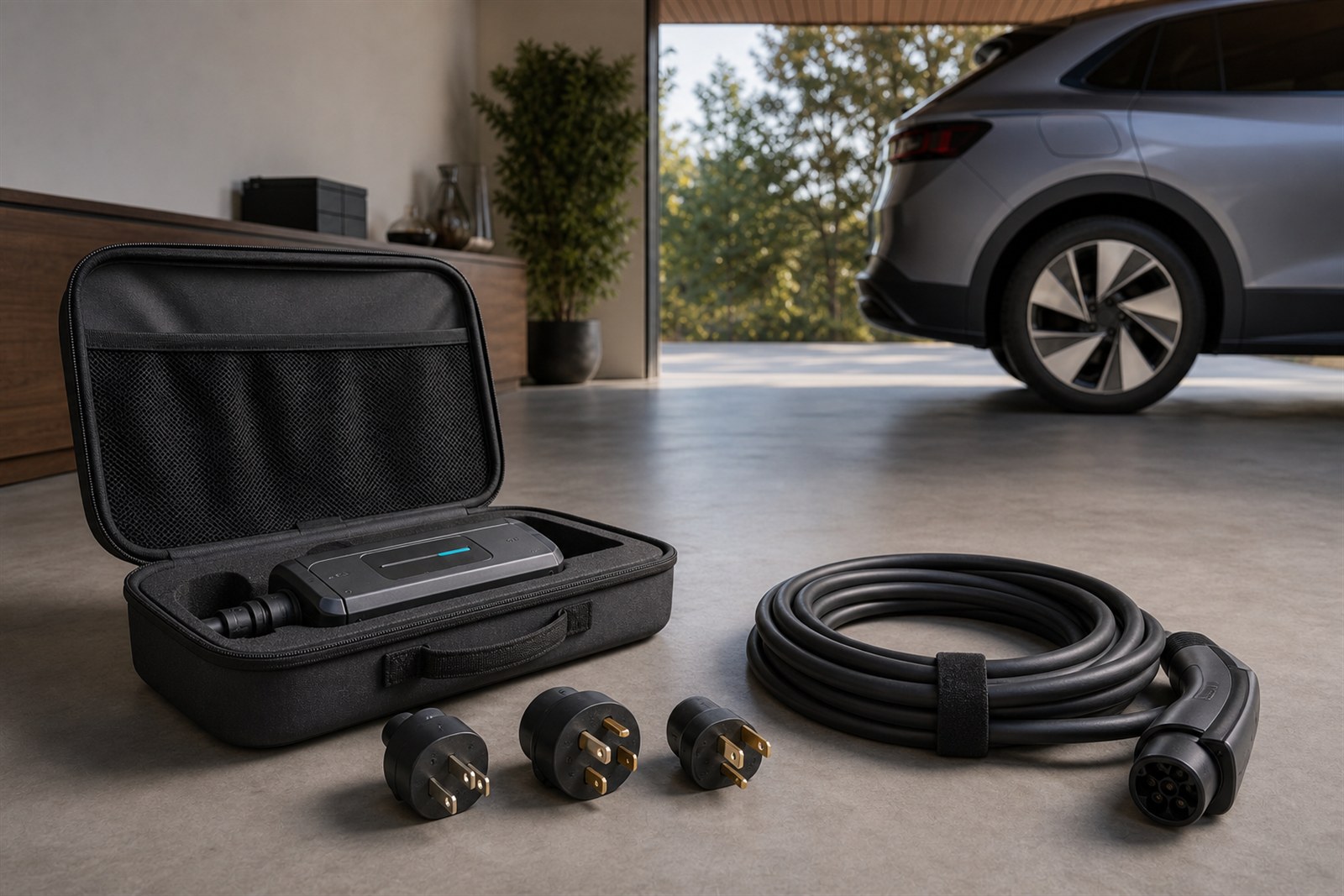
Quick answer: Tesla/NACS drivers get the cleanest fit from the Tesla Mobile Connector. For J1772 drivers who want the widest documented outlet flexibility and rugged construction, the J+ BOOSTER 2 is the premium choice. The Webasto Go is the simpler 32-amp dual-voltage option. The Grizzl-E Mini emphasizes a rugged enclosure and local controls. Rivian owners replacing the factory cord should start with the Rivian Portable Charger.
Documented Amazon listings already on this page: J+ BOOSTER 2 · Webasto Go · Grizzl-E Mini · Lectron portable. Tesla and Rivian kits stay on the manufacturer pages below.
A portable EV charger is better described as a portable EVSE: it tells the car how much current is available, checks for faults, and switches power safely. It does not store electricity. If the battery is empty on the shoulder, the cable alone cannot rescue the car; it still needs a compatible live outlet.
Portable EV Charger Comparison
| Portable charger | Connector | Maximum | Included outlet support | Documented distinction | Best fit |
|---|---|---|---|---|---|
| Tesla Mobile Connector | NACS | 32A on 240V | NEMA 5-15 and 14-50 | 20-ft cable; additional Tesla outlet adapters available | Tesla/NACS simplicity |
| J+ BOOSTER 2 | J1772 | 40A / 9.6 kW | NEMA 5-15 and 14-50; more approved adapters sold separately | ETL certified to listed UL standards; IP67; 25-ft cable | Maximum travel flexibility |
| Webasto Go | J1772 | 32A / 7.7 kW | NEMA 5-15 and 14-50 | UL/cUL language, IP67, plug-temperature monitoring, 20-ft cable | Simple dual-voltage kit |
| Grizzl-E Mini | J1772; connector offering varies | 40A / up to 10 kW | 14-50 base plus documented adapter options | NEMA 4X aluminum enclosure, adjustable 7–40A, local smart controls | Rugged adjustable setup |
| Rivian Portable Charger | J1772 | 32A / 7.6 kW | NEMA 5-15 and 14-50 | 18-ft cable and Rivian-published installation guidance | Rivian factory replacement |
Important: confirm the current manual and exact box contents before purchase. Product revisions, connector offerings, adapters, and availability can change.
Outlet & Range Estimator
The outlet sets the ceiling, the portable charger may set a lower ceiling, and the vehicle's onboard AC charger can limit it again. This calculator uses the lowest of the outlet's continuous-current limit and your portable charger's maximum.
How many miles can your outlet add?
Assumes 85% wall-to-battery efficiency on 120V and 90% on 240V. Cold weather, battery conditioning, charge level, voltage sag, and the vehicle's onboard charger can reduce results. This does not verify that an outlet or circuit is safe.
The Five Picks, Explained
Best for Tesla and native NACS1. Tesla Mobile Connector
The Tesla kit is the simplest travel answer for a Tesla or compatible NACS vehicle: native connector, automatic current limits through Tesla's plug adapters, a 20-foot cable, and both common 120V and 240V adapters in the current kit. Tesla documents up to roughly 3 miles of range per hour from a standard household outlet and up to roughly 30 miles per hour from a NEMA 14-50, depending on vehicle.
Tradeoff: its 32A maximum is slower than a 40A portable unit, non-Tesla compatibility must be checked by vehicle, and Tesla's current U.S. shop says buyers must sign in with an eligible Tesla-owner account. That speed difference rarely matters over a full overnight stop.
Check the current Tesla Mobile Connector kit →Manufacturer documentation · non-affiliate link Best premium travel system2. J+ BOOSTER 2
J+ documents 120V and 240V operation, selectable current from 6A through 40A, NEMA 5-15 and 14-50 adapters in the Dual Traveler kit, optional adapters for several other outlets, a 25-foot cable, IP67 protection, and ETL certification for compliance with UL 2594 and related personnel-protection standards. That combination makes it the most versatile documented system in this group.
Tradeoff: it is the expensive option. Buy the flexibility only if you will actually use multiple outlets or want one unit to serve as both travel kit and home charger.
Check current J+ BOOSTER 2 specifications →Manufacturer documentation · non-affiliate link Check current price on Amazon →Amazon affiliate link · VoltEdge may earn a commission at no extra cost to you Best simple 32A J1772 kit3. Webasto Go
Webasto documents a 32A maximum, dual 120V/240V operation, NEMA 5-15 and 14-50 grid plugs, a 20-foot cable, IP67 protection, automatic adapter detection, and temperature monitoring at the grid plug. It is a straightforward choice when you want OEM-style simplicity without an app or a large adapter collection.
Tradeoff: verify current retail availability and exactly which branded version you are buying; closely related Webasto-built cords have appeared under several automaker brands.
Read Webasto's documented Go specifications →Manufacturer documentation · non-affiliate link Check current price on Amazon →Amazon affiliate link · VoltEdge may earn a commission at no extra cost to you Best rugged enclosure and local controls4. Grizzl-E Mini
The Grizzl-E Mini emphasizes a compact NEMA 4X aluminum enclosure, 120V/240V operation, adjustable 7–40A output, a carrying case, and local smart controls for scheduling and energy tracking. It is the option here most clearly shaped like a compact wall unit that can travel.
Tradeoff: Grizzl-E's current product lineup and connector/adapter packages have changed. Verify the exact current model, certification mark, connector, adapters, and manual before buying rather than relying on an older listing.
Check Grizzl-E's current documentation →Manufacturer documentation · non-affiliate link Check current price on Amazon →Amazon affiliate link · VoltEdge may earn a commission at no extra cost to you Best factory-match replacement for Rivian5. Rivian Portable Charger
Rivian's current gear listing identifies a J1772 portable charger rated at 32A with an 18-foot cable, and Rivian publishes a dedicated 240V outlet installation guide stating the same 32A maximum draw. That makes it the least complicated starting point for a Rivian owner replacing or duplicating the factory travel cord.
Tradeoff: it is an owner-specific pick, not the broadest multi-outlet travel system. Rivian's current J1772 listing also says it is unavailable for shipment to California. Confirm current package contents, shipping eligibility, and compatibility before ordering.
Check the current Rivian Portable Charger →Manufacturer documentation · non-affiliate linkAlso on Amazon: two more portable-friendly options
Two additional units sold on Amazon — a recognizable budget-friendly portable pick, and a permanent wall charger for readers who decide portability is not the real need. These are affiliate links; VoltEdge may earn a commission at no extra cost to you, and it does not change the picks, order, specifications, or safety standard above.
- Lectron Level 1/Level 2 portable (dual NEMA 5-15 & 14-50 plugs): a widely sold, budget-friendly portable option for J1772 EVs. Check current price on Amazon →Amazon affiliate link · VoltEdge may earn a commission at no extra cost to you
- Grizzl-E Classic (permanent wall unit, not portable): if the charger will live on one wall, a fixed home EVSE is often the cleaner long-term answer than a travel kit. Check current price on Amazon →Amazon affiliate link · VoltEdge may earn a commission at no extra cost to you
AC connector adapters: match the direction
An adapter can solve an AC connector mismatch, but direction matters and neither of these products enables DC fast charging. Confirm that the vehicle and charging-equipment manufacturers allow the exact combination before buying.
- A2Z Atom — J1772 charger to NACS vehicle: A2Z lists an 80A rating, UL 2252/CSA-C22.2 certification, an interlock, and compatibility with Level 1/2 J1772 charging for a NACS-equipped vehicle. Check the Atom adapter at A2Z EV →A2Z EV affiliate link · 10% off with code TYLERJBLASER while active
- A2Z Stellar — NACS charger to J1772 vehicle: A2Z lists an 80A rating, UL 2252/CSA-C22.2 certification, dual over-temperature sensor switches, and compatibility with NACS AC wall, destination, and mobile chargers. It is explicitly not for NACS DC charging. Check the Stellar adapter at A2Z EV →A2Z EV affiliate link · 10% off with code TYLERJBLASER while active
A2Z reader discount: Enter code TYLERJBLASER at checkout for 10% off while A2Z keeps that offer active. These are affiliate links; VoltEdge may earn a commission, and the discount and commission do not change the safety guidance above.
Eight Questions to Answer Before You Buy
A portable charger is only useful when the entire chain works together: the building circuit, receptacle, approved adapter, EVSE, vehicle connector, onboard AC charger, parking position, and charging time. Answer these before paying for speed or a large adapter bundle.
- Which connector does the vehicle accept for AC charging? Match J1772 or NACS/J3400 to the vehicle first. An adapter may work, but only when the vehicle and charger manufacturers support that exact AC combination.
- Which outlets will you actually use? Photograph the receptacles at home, a cabin, or a regular destination and have uncertain circuits identified. Similar-looking plugs can have different voltage and current limits.
- What is the lowest limit in the chain? A 40A EVSE cannot deliver 40A through a 30A circuit, and a vehicle with a 32A onboard limit will not accept 40A even from a larger unit.
- Is the equipment safety certified? Look for a current certification mark from a nationally recognized testing laboratory such as UL or ETL, then confirm the exact model—not just the brand—appears in the documentation.
- Can the cable reach without an extension cord? Measure from the receptacle to the charge port with the vehicle parked both ways. Include routing that avoids a trip hazard, sharp bend, closed door, or tension on the plug.
- Will it be used outside? Verify the complete product's environmental rating and manual. A weather-rated control box does not automatically make an outlet, adapter junction, or damaged connector safe in rain.
- Does the plug monitor temperature? Temperature sensing can reduce or stop current when a supported plug connection overheats. It is valuable protection, but it does not repair a worn receptacle or bad wiring.
- Is portability solving a real problem? If the charger will stay on one wall, compare a permanent home EVSE. A hardwired installation can remove a high-current plug connection and may be the cleaner long-term answer.
How to Avoid Paying for Charging Speed You Cannot Use
Start with the miles that need to be replaced, not the charger's largest amp number. A driver using 35 miles per day and averaging 3.5 mi/kWh needs roughly 10 kWh in the battery. Allowing for charging losses, that is about 11–12 kWh from the wall. A common 120V/12A setup can be enough when the car sits for a long night; a 240V/16A setup can replace that energy in only a few hours. Use the estimator above for the outlet you already have, then use the VoltEdge charging-cost calculator to turn the energy into dollars at your utility rate.
The jump from 32A to 40A sounds large, but it is a 25% increase in current—not a transformation from slow to fast. At 240V, the theoretical wall power rises from 7.68 kW to 9.6 kW. You only receive that gain when the circuit, EVSE, and vehicle all support 40A. If the vehicle's onboard AC charger stops at 32A, buying a 40A portable unit will not shorten that charging session.
Money-saving move: test the daily-mile requirement against an existing, inspected outlet before assuming you need a new 50A circuit. EPA's current home-charging guidance notes that some drivers can meet their needs with lower-power charging, while higher-amperage installations can add equipment, wiring, permitting, and panel costs. If a new circuit is being considered, take the result to a qualified electrician and use VoltEdge's panel conversation estimator to prepare the right questions.
What Outlet Can You Safely Use?
NEMA 5-15: the familiar household outlet. A compatible portable EVSE typically limits charging to 12A continuous. It is slow but useful overnight when daily mileage is modest.
NEMA 5-20: still 120V, but on a 20A circuit with a different receptacle face. The portable EVSE needs a manufacturer-approved 5-20 adapter to use the 16A continuous limit.
NEMA 6-20: a compact 240V, 20A outlet. At 16A continuous it can provide a meaningful overnight refill without a 50A circuit, but only if the EVSE supports the exact plug.
NEMA 14-30: common for newer dryers. A 30A circuit supports 24A continuous EV charging. Do not use a generic adapter that lets a 32A or 40A charger overdraw the circuit.
NEMA 14-50: common for RVs and home EV charging. A 50A circuit supports up to 40A continuous, but the portable charger or vehicle may cap the session lower.
Safety rule: never assume that an outlet is healthy because the plug fits. EV charging is a long continuous load. Have older, loose, heat-discolored, frequently used, outdoor, or unknown receptacles and circuits checked by a qualified electrician. Do not run a portable EV charger through an ordinary extension cord or an unapproved adapter chain.
Who Actually Needs a Portable Charger?
| Situation | Portable kit value | Better answer when possible |
|---|---|---|
| Regular overnight parking at one home | Useful as backup | Dedicated hardwired or quality plug-in home EVSE |
| Frequent visits to family, cabins, or RV sites | High—if outlets are verified | Portable kit with approved adapters |
| Renter who may move | High when a suitable outlet already exists | Landlord-approved installation and inspected circuit |
| Roadside emergency with no powered outlet | Low—the cable stores no energy | Roadside charging service or tow |
| Daily high-mileage driving | Depends on 240V access | Permanent Level 2 installation |
What to Pack With a Portable EV Charger
The charger is only one part of a useful travel kit. A few minutes of preparation can prevent an expensive cord from becoming dead weight at the destination.
- Only the manufacturer-approved adapters you expect to use. Label each one by outlet type so nobody chooses by appearance alone.
- The current manual, saved offline. Cell service can be poor at cabins, campsites, and rural stops. Keep the fault-light meanings and current-selection instructions on the phone.
- A simple outlet plan. Confirm permission, receptacle type, voltage, parking location, cable reach, and whether the circuit serves another large load before the trip.
- A clean, dry storage case. Protect connector pins and plug blades from dirt, impact, and loose cargo. Inspect the cable, enclosure, adapters, and contacts before each use.
- A backup charging location. Save a nearby public charger or roadside-assistance option. A portable EVSE is a flexible charging tool, not stored emergency energy.
Do not add an ordinary extension cord, bargain adapter chain, or multi-outlet splitter to “make it work.” Those shortcuts can bypass the current-limiting logic built into an approved adapter and add hot, weather-exposed connections.
Portable EV Charging Fun Facts
- The box on the cable is not usually the battery charger. It is EV supply equipment that communicates available current and switches power. For AC charging, the car's onboard charger converts AC electricity to DC for the battery.
- Ten hours on a basic outlet is not zero. A 120V, 12A session supplies 14.4 kWh at the wall over ten hours. Using this page's conservative 85% assumption, about 12.2 kWh reaches the battery—roughly 43 miles at 3.5 mi/kWh.
- A 40A EVSE normally pairs with a 50A circuit. EPA explains the same 125% circuit-sizing relationship in its home-charging guidance. That continuous-load rule is why the outlet name and breaker number are not the charger's usable current.
- Faster is not always more useful. Charging happens while the vehicle is parked. If 16A replaces tomorrow's driving before departure, unused 40A capability adds no time savings that night.
- Plug shape is only the beginning. Connector fit, AC versus DC operation, adapter approval, voltage, current, vehicle limits, and software support all matter. “It plugs in” is not the same as “the manufacturer supports it.”
Frequently Asked Questions
Can a portable EV charger rescue a stranded EV?
Usually no. The device is a power-control cable, not a battery. It still needs a compatible powered outlet. A true roadside rescue needs stored/generator power, a compatible vehicle-to-vehicle setup, or a tow.
How fast will it add range?
A common 120V setup adds roughly 3–5 miles per hour. Depending on circuit, charger, vehicle, and weather, 240V portable charging can add roughly 12–35 miles per hour. Use the estimator above for your scenario.
Can I use an RV outlet?
Only when the EVSE and its manufacturer-approved adapter support that exact receptacle and voltage. RV parks can have worn outlets or voltage problems, so inspect the connection and stop if the plug or receptacle becomes hot.
Is outdoor charging safe?
Use only equipment whose current documentation permits outdoor operation. Keep plug/adapter junctions out of standing water, seat every connector fully, and follow the manufacturer's temperature and weather limits.
Should I buy NACS or J1772?
Prefer the connector native to your vehicle. If an adapter is necessary, use an OEM-approved product and confirm AC compatibility. A physical fit does not guarantee that a charging combination is supported.
Primary Sources
- Tesla Mobile Connector product documentation
- J+ BOOSTER 2 specifications and certification language
- Webasto Go launch specifications
- Grizzl-E product FAQ
- Rivian Portable Charger listing and 240V outlet guide
- A2Z EV product documentation for the Atom J1772-to-NACS AC adapter and Stellar NACS-to-J1772 AC adapter
- U.S. EPA home EV charging guidance
- U.S. EPA Home EV Charger Calculator
Bottom Line
Buy for the outlets you will genuinely encounter—not the largest adapter bundle. Native vehicle connector, clear current limiting, verifiable safety documentation, plug-temperature protection, and a cable that reaches without an extension cord matter more than an app. For a permanent installation, compare the best home EV chargers; for the monthly cost, use VoltEdge's charging-cost calculator; if panel capacity is the concern, start with the panel conversation estimator; and if outage backup is also on your list, read portable power station sizing separately from travel charging.
Want to support more independent tools like this? Browse the VoltEdge shop. Affiliate links are labeled where they appear, and compensation never changes the rankings.