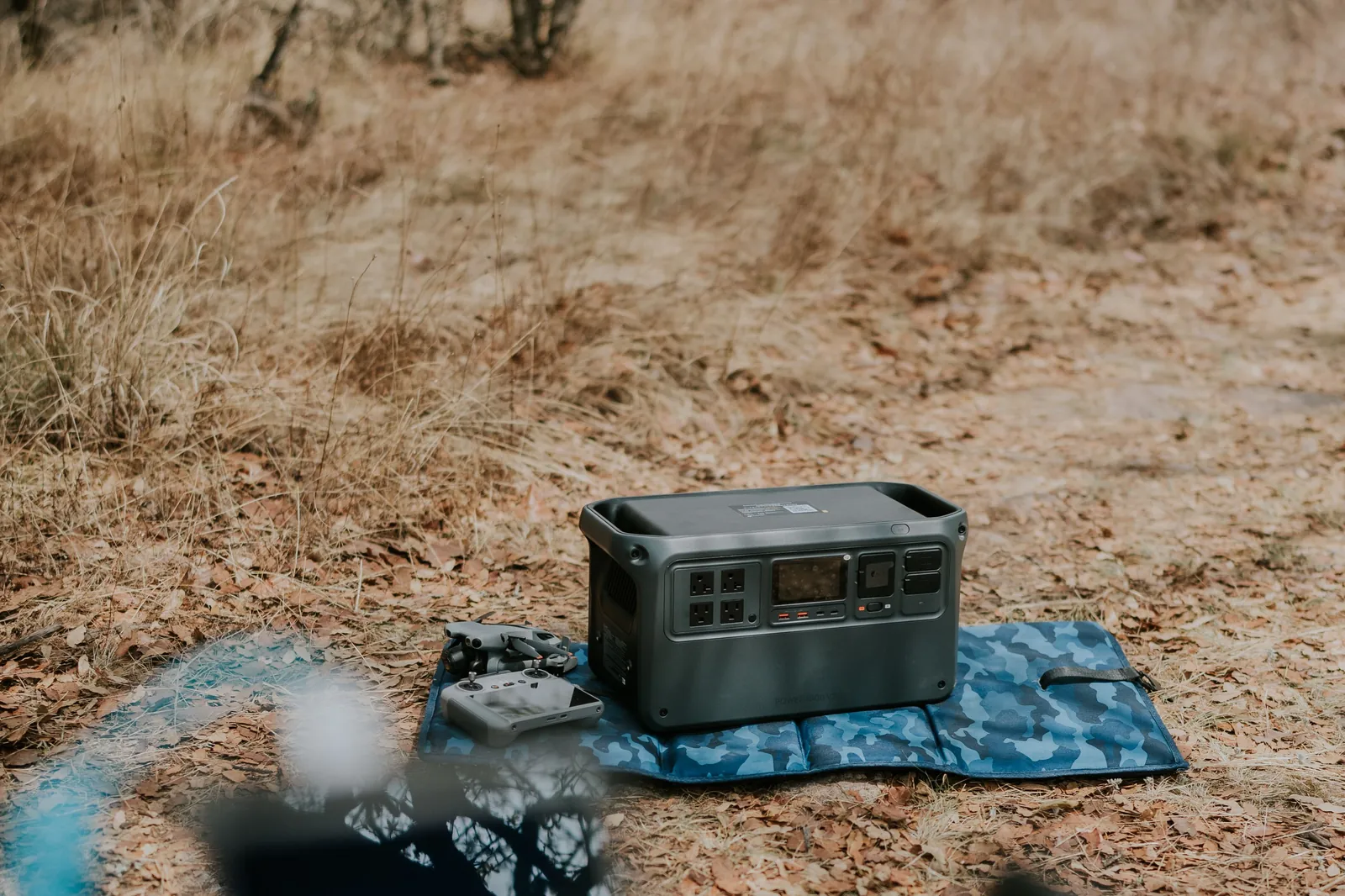
Short answer: Yes, a portable power station can charge an EV through a Level 1 cord, but only for a few emergency miles. With BLUETTI’s published AC180 figures (1,152 Wh, 90% usable, 85% inverter efficiency) and an example 15% charging loss, a car using 300 Wh per mile gets about 2.5 miles from a full station in roughly 36 minutes. That’s enough to reach a parking spot, a charger a couple of miles away, or a tow pickup point. It is not a charging plan. Run your own numbers in the miles-added calculator.
Search “can a power station charge an EV” and you’ll find two kinds of answers: marketing that implies a meaningful top-up, and forum threads where people tried it and got almost nothing. The physics settles it. A portable station stores roughly one to two kilowatt-hours. Every conversion step loses some of that. Then the car spends what’s left at its normal rate per mile. This page does that math transparently with numbers you can change, and it tells you what has to be true for the connection to work at all.
Miles-added calculator
Pick a station or enter your own. Every value is editable. Nothing is stored or sent anywhere.
Formula: hours = capacity × usable % × inverter efficiency ÷ (cord draw + 15 W station self-consumption), from BLUETTI’s published runtime formula. Miles = hours × cord draw × (1 − charging loss) ÷ Wh per mile. Educational estimate only.
Why the answer is so small
Follow the energy for the AC180 example. The station holds 1,152 Wh. BLUETTI’s own runtime formula counts 90% of that as usable and 85% as surviving the inverter, and it adds about 15 W of self-consumption. At a 1,440 W Level 1 draw, that works out to roughly 872 Wh of AC delivered over about 36 minutes. Take off an example 15% for the cord and the car’s onboard charger and about 740 Wh reaches the battery. At 300 Wh per mile, that’s about 2.5 miles.
Doubling the station roughly doubles the miles. Using the same 90% and 85% assumptions, a 2,048 Wh unit works out to about 4.4 miles at 300 Wh/mi. Those assumptions are BLUETTI’s AC180 figures, applied here for illustration. Even a large portable station adds single-digit miles, because an EV battery is many times larger than any portable station.
Which Wh-per-mile number should you use?
Use the energy figure from your car’s trip meter or energy screen and keep a charging-loss value. If you take the kWh/100 mi figure from the EPA label instead, set charging loss to 0. The EPA says its electric-vehicle figures assume Level 2 AC charging and include losses from the charging cable (EVSE) and the onboard charger, so the label already measures from the wall outlet (EPA, Fuel Economy and EV Range Testing). Charging losses also vary with the vehicle, the charging equipment, battery state and weather (fueleconomy.gov). That is why the loss input is editable and labeled as an assumption.
What has to be true for it to work at all
- The inverter must carry the cord continuously. A Level 1 cord at 12 A on 120 V draws about 1,440 W for the whole session. The station’s continuous AC rating has to clear that. Surge, peak and “lifting” or power-lifting modes don’t count. All four stations in the calculator list rated inverter outputs of 1,800 W or more. If yours is smaller, lower the car’s charging current if it allows it, or don’t try.
- Use a standard 120 V AC outlet on the station. Plug the car’s own Level 1 cord (portable EVSE) into it. Don’t use adapters you can’t identify, and don’t plug in through a long, thin extension cord.
- The EVSE may refuse to start. Portable charging cords run safety checks (ground and fault detection) before they close their relay. Some owners report that a given cord won’t start on a given power station. We have not tested any pairing and make no compatibility claim for any brand. Check the EVSE manual and the station maker’s support pages.
- Cold matters twice. Many LiFePO4 stations won’t recharge below freezing: BLUETTI lists the AC180’s charging range as 32–104 °F. And a cold EV uses more energy per mile. Our winter EV charging guide covers both.
Better options first: If any wall outlet is within reach, a portable Level 1/Level 2 EVSE on that outlet will out-charge a power station within the hour, and it keeps going. On the road, a public charger or your roadside-assistance tow is the real fix. A power station is for the last couple of miles.
If you’re buying a station for outages anyway
The honest reason to own one is home backup and camping, with the EV trickle as a bonus. Size it for the fridge, router and CPAP with our outage runtime calculator and the power station guide. If you also want the emergency-mile option, pick one whose rated (not peak) AC output clears 1,440 W. The four below list ratings above that on their maker pages (checked November 10, 2026). We list specs only, not prices.
BLUETTI AC180
1,152 Wh LiFePO4, 1,800 W continuous AC (2,700 W lifting mode, which doesn’t count for an EV cord). BLUETTI publishes the 90% / 85% / 15 W runtime figures used above for this model.
BLUETTI AC200L
2,048 Wh LiFePO4, 2,400 W continuous AC. Roughly double the AC180’s emergency miles in the calculator.
See the AC200L at BLUETTI (sold out Nov 10)
BLUETTI showed the AC200L as sold out on Nov 10, 2026. Closest in-stock BLUETTI: Elite 200 V2 (2,073.6 Wh, 2,600 W) at BLUETTI.
ALLPOWERS R1500
1,152 Wh LiFePO4, 1,800 W pure sine wave inverter (3,000 W peak), per ALLPOWERS’ listing. We didn’t find depth-of-discharge or inverter-efficiency figures on that listing, so the calculator keeps the editable BLUETTI defaults.
ALLPOWERS R2500 Plus
2,016 Wh, 2,500 W pure sine wave inverter (4,000 W peak), per ALLPOWERS’ listing.
See the R2500 Plus at ALLPOWERS (sold out Nov 10)
ALLPOWERS showed the R2500 Plus as sold out on Nov 10, 2026. Closest in-stock ALLPOWERS: R2500 V2 (1,920 Wh, 2,500 W) at ALLPOWERS.
Frequently asked questions
How many miles will a 1,000 Wh power station add?
With the calculator’s defaults (90% usable, 85% inverter efficiency, 15% charging loss, 300 Wh/mi), about 2 miles. Change the inputs to match your car and your station.
Can I charge an EV from a power station with Level 2?
Only if the station has a 240 V output and enough continuous capacity for a Level 2 EVSE, so check its spec sheet. Level 2 wouldn’t add more miles anyway. Miles are limited by stored energy, not charging speed.
Can solar panels on the station keep the car charging?
A station can charge from panels and discharge to the car, but daily solar input on a portable kit is small compared with a car’s daily energy use. Treat it as a slow emergency top-up, not daily charging. Our solar power guide covers sizing.
Will it hurt the car or the station?
Running within the station’s continuous rating, with the car’s own charging cord, is ordinary use for both. Drawing near the inverter limit for the whole session makes the station work hard and run its fans. Follow both manuals, and stop if either shows a fault.